
Exploring Information Science and Cybersecurity Research and Potential Academic Collaboration at the 88th ASIS&T Annual Meeting – Dimaz Ardhi
This is part 4 of the blog series where we share reflections from our 2025 NEASIS&T Conference Support Award recipients, offering a glimpse into the value and impact of the 2025 ASIS&T Annual Meeting. Through their experiences, we aim to highlight the learning, networking, and growth that make this event so impactful.
Attending the Association for Information Science and Technology (ASIS&T) Annual Meeting was a particularly meaningful experience for me as an information science student. I had the opportunity to participate in the ASIS&T Annual Meeting, one of the largest international conferences in Information Science and Technology, held from Sunday, November 14 to Thursday, November 18, 2025, at the Hyatt Regency Crystal City in Arlington, Virginia, United States of America. The experience began a day earlier with an open reception on Saturday, which provided an informal setting for networking and professional exchange.
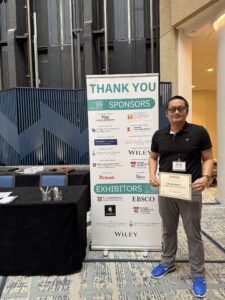
During the welcoming reception, I had the opportunity to connect with several faculty members and fellow doctoral students, including participants in the doctoral colloquium. Hearing firsthand about their academic journeys and experiences in the colloquium was both motivating and inspiring, and it encouraged me to apply for the doctoral colloquium at the 89th ASIS&T Annual Meeting next year, to be held in Bangkok, Thailand. On the same day, I had the opportunity to reconnect with a friend I had not seen in person for a few years, as well as with a professor I had met at another conference. We exchanged the latest information and knowledge in the field of Information Science, which made a good start to the conference and was welcoming to me as a first-time attendee of the ASIS&T annual meeting.
Throughout the conference, I actively participated in a wide range of events, including guest speaker, panel discussions, paper presentations, and poster sessions. One panel discussion stood out to me, as it featured an open and engaging exchange between the speakers and the audience on their experiences with the rapid development of artificial intelligence in both academic and professional settings. This discussion prompted meaningful reflection on how we should approach this rapidly evolving technology in the future, how to use it responsibly and effectively, and why exercising caution is especially important within academic environments.
I attended a paper session that examined YouTube comments in the context of mental health and sentiment analysis. Although the topic was outside my primary focus in cybersecurity, I was particularly interested in the study’s methodological approach. During the coffee break, I took the opportunity to introduce myself to the presenter and discuss his work. I began by referencing a question raised during the session regarding the choice of YouTube as the data source. I shared my perspective that YouTube represents a contemporary form of information-seeking behavior, as users frequently rely on “how-to” videos for guidance and learning. I also expressed how his research inspired me and asked for his advice on appropriate methods for conducting similar studies. He recommended using Python, noting its advantages for working with data obtained via APIs, including JSON formats, and also mentioned practical considerations such as API access costs. It was a great experience to be able to discuss my
research with other scholars outside of the college where I am currently pursuing my doctoral
degree.
I attended many paper sessions during the conference, but the one that left the strongest impression on me was a session focused on cybersecurity. I had the opportunity to attend a presentation of a paper titled Bridge or Blindspot? A Visual Analysis of Representation and Narrative in Cybersecurity Across Expertise Groups, presented by a student from Taiwan. I was particularly impressed by the methodological approach, which asked participants to visually represent what cybersecurity meant to them based on their own perspectives.
Although I did not have the opportunity to ask questions during the session, the presenter later visited my poster presentation. This gave us the chance to discuss both my study and hers, as well as to reflect on shared challenges in qualitative research, especially the difficulty of eliciting rich insights when participants are less expressive or reluctant to share in depth. Another cybersecurity paper session that I found particularly engaging was a presentation titled Think or Respond: Understanding the Impact of Cognitive Appraisals on Threat Detection and Phishing Susceptibility. This study resonated strongly with me because it applied Rogers’ Protection Motivation Theory (PMT), the same theoretical framework that underpins my own research, albeit within a different application context.
In conclusion, this conference was highly beneficial to my academic and professional development. It not only expanded my knowledge and inspired directions for future research but also allowed me to broaden my professional network. The various events and receptions provided valuable opportunities to engage in meaningful conversations, build lasting relationships, and explore potential collaborations, including joint writing projects, information sharing about future conferences, and career opportunities. Lastly, I would like to sincerely thank NEASIS&T for providing the scholarship that made it possible for me to attend this conference.