Reflections on Attending the 88th ASIS&T Annual Meeting: Learning, Presenting, and Scholarly Engagement Experience – Dwi Puspita Sari
This is part 3 of the blog series where we share reflections from our 2025 NEASIS&T Conference Support Award recipients, offering a glimpse into the value and impact of the 2025 ASIS&T Annual Meeting. Through their experiences, we aim to highlight the learning, networking, and growth that make this event so impactful.
In 2025, I marked my first time attending the Annual Meeting of the Association for Information Science and Technology (ASIS&T), held at the Hyatt Regency Crystal City in Virginia. The 88th ASIS&T Annual Meeting adopted the theme “Difficult Conversations: The Role of Information Science in the Age of Human-Centered Artificial Intelligence”, held from November 14 to November 18, 2025. As a doctoral student pursuing a degree in Information Science, I am grateful for the opportunity to attend this highly reputable conference, supported by NEASIS&T. The experience was extremely valuable, as it allowed me to learn about the latest research in Information Science, receive feedback on my poster presentation, and connect with scholars and practitioners in the field of Information Science.
First, in my opinion, attending a conference is fundamentally about learning emerging research in the field. I was particularly impressed by the breadth and depth of knowledge presented by scholars at this conference, especially in ongoing research on Information Science and Artificial Intelligence (AI). By attending various sessions, I learned that many organizations (e.g., museums and libraries) are increasingly aware of the rapid rise of AI and are actively adapting to its development. While AI technologies offer significant benefits, they also introduce new challenges that exceed the scope of existing literacy frameworks. From the various research presented during the sessions, I learned that trusted civic institutions are now required to develop new competencies in AI literacy, ethical evaluation, and algorithmic understanding.
I also learned that these organizations have begun educating communities on how to recognize and address challenges such as misinformation, fake news, and deepfakes enabled by AI technologies. In addition, many civic institutions have begun implementing and adopting AI technologies to support their organizational processes. Through the presentations, the scholars share their experiences (e.g., usefulness, satisfaction, and accuracy) at different sessions of this conference. This demonstrated how AI technologies can support and enhance human life when they are used wisely.
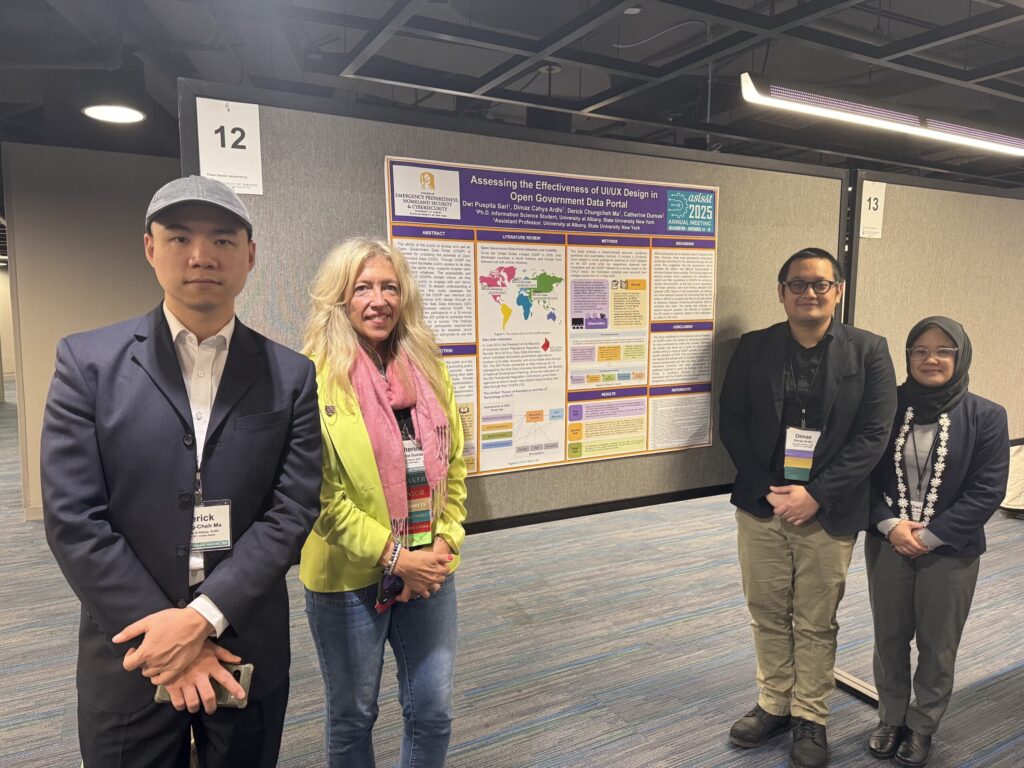
Second, this conference not only provided exposure to cutting-edge research in Information Science in the era of AI but also offered me the opportunity to present my poster on Monday, November 17, 2025. Together with my three co-authors of this poster from the University at Albany (Dimaz Cahya Ardhi, Derick Chung-Cheh Ma, and Dr. Catherine Dumas), we presented our poster titled Assessing the Effectiveness of UI/UX Design in Open Government Data Portals: An Experiment. We had the opportunity to explain our research to conference attendees and received valuable feedback from diverse perspectives. I carefully documented the comments, suggestions, and recommendations provided, which will guide me into the next phase of this ongoing project, which I plan to develop into a full-length paper for future publication.
Third, beyond learning from research presentations, engaging with other Information Science scholars was a critical component of this experience. As this was my first opportunity to connect extensively with Information Science students and scholars, it provided a new perspective on my academic work. During my doctoral studies, I have primarily attended conferences focused on digital government and information systems, where discussions often emphasized information technology and public-sector perspectives. In contrast, this conference broadened my horizons by allowing me to view my research topics through a wider information science lens. As an internationally recognized conference, ASIS&T also attracted attendees from around the world, and conversations with participants highlighted perspectives beyond the U.S. context. Additionally, I greatly valued the opportunity to meet other doctoral students in Information Science from across the country, with whom I exchanged insights about research interests, coursework, and ongoing projects. These conversations provided meaningful insight into the diverse experiences of Information Science doctoral students.
Finally, I am deeply grateful and would like to express my sincere gratitude to NEASIS&T for supporting my attendance at the ASIS&T Annual Meeting 2025. I believe that this opportunity significantly expanded my perspective and understanding of the field of Information Science in ways I had not experienced at any other conference during my doctoral journey. This opportunity has meaningfully strengthened my ability to contribute to the field of information science. I hope that this first opportunity to attend the ASIS&T Annual Meeting marks not an endpoint, but the beginning of many years of continued engagement and participation in this vibrant scholarly community.